One of the most iconic advertising slogans ever produced was for Fram Oil Filters, “You can pay me now, or pay me later”. The simple but powerful message was, proper maintenance of your vehicle will save you lots of money and headaches down the road.
So, how does that translate to media sales? Imagine for a minute that one of your biggest accounts just announced they intend to make some drastic cuts. They currently use several radio groups, outdoor, and TV in their traditional media portfolio. When this happens, sometimes we know they are simply fishing for a “better deal”.
However, if they are truly making cuts, more than likely the client was already forming hard-to-change perceptions on which media or media rep they should cut long before that cut-back announcement was made.
“Preventive maintenance” is always more effective, and less costly, than “damage control”. It will not only save you money, but also a ton of headaches and heartaches!
Do you have a preventive maintenance program or does all of your energy go into making the sale, looking for new business, and damage control?
A well-planned system of bringing “value” to your customers and being a resource to them rather than simply selling them and sending them invoices is key to keeping them, especially when it comes time to make cuts.
ENS Media’s SoundADvice Program is a proven system that will help media reps and stations build powerful relationships with their clients and prospects.
If you’re surprised by a cancellation or cutback, it’s probably because you didn’t have a preventive maintenance program. Here’s a recent testimonial that speaks directly to how SoundADvice can help keep YOU from the chopping block:
Good morning, Rick.
Thank you for the scripts. We record them every week featuring a different sales team member and they are being well received by clients.
We had a local body shop that had pulled his 15+ year consistent annual ($xx,000/year) at the start of all this COVID craziness. A few weeks ago, he called our team member to have him come back in to talk about getting back on because he said he AND his staff have been listening to the SoundADvice messages and they really speak to them.
Great stuff!
One of our most recent subscriber’s comments on the pricing of SoundADvice was… “Wow, why wouldn’t we do it!”
If you would like to implement a preventative maintenance program, click here to arrange a time to visit, or call Rick at (605) 310-2062 to learn more about our SoundADvice Program.
Show me a good prospector and I’ll show you a good media rep.
When working with and training media sales reps, we always suggest that there are two styles of prospecting… prospecting “hard” and prospecting “smart”.
The question is, which one is better and which type do you want on your team?
I suggest the answer is… both!
Prospect “hard” when you are new and trying to build a base or when billing is struggling and you need to rebuild fast. Prospect “smart” once you’re established and you can focus on finding clients with bigger and better potential. There are positives and negatives to each.
If I were to go into any radio station and ask this one question, “Which rep(s) prospects the hardest on your sales team?”, I would then be able to tell you several other things about them. First and foremost, I want them on my team! I like reps that work hard and aren’t afraid of rejection. It would also tell me who has the most “new clients” on the air at nearly any given time… but, at the same time, it would tell me who has the most cancellations. This is not always true, but most of the time it is.
On the other side of the prospecting coin, the sales rep that prospects the “smartest” usually has a much better closing ratio, larger contracts, more annuals, better relationships with their clients, and therefore fewer cancellations, and, they don’t have to work nearly as hard. But… more often than not, they have fewer prospects in the sales funnel and when they do get that dreaded cancellation, it can hurt.
Prospecting is a little bit like the story of The Tortoise and the Hare. They are both worthy of being in the race, but the one that is always moving and consciously makes prospecting a part of their weekly plan, and never lets up will usually win the race.
Understanding where the sales rep is in their career and their current level of business can most often determine what approach or tactic they should be using.
The moral of the story… ALWAYS be consciously Prospecting!
The goal of every ad is to get people to “listen to the ad” and “recall” the ad. I refer to it as… “leaning forward”.
When visiting with a client or a potential client, I oftentimes use the Super Bowl and the ads within to make this point. I make statements or ask questions like…
“There is only one time a year when people ‘want’ to see or hear ads. Do you know when that is?”
Then I wait for their answer. Approximately 40-50% of the people will guess the Super Bowl. The others say during Black Friday or Christmas. I use this statement to get the person I am speaking with to understand “how” people consume media. Only during the Super Bowl do people actually “lean forward” to see and hear ads. The other 364 days a year, we need to actually grab their attention, because when the commercial break comes on, people “lean back”.
Being honest with them about “how” people consume media will get them to believe you and listen to you more intently as you progress through the sales process.
I also ask or suggest this…
“Do you ever wonder why a large majority of the ads during the Super Bowl are 60-second ads, and the rest of the year, these same advertisers run 30-second ads?”
So why do I make these statements? Because most business owners believe 60-second ads are “too long” and they believe “no one listens to ads”. In many cases they are right, no one likes “bad ads” and bad ads struggle to capture the listeners/viewers’ attention. To make my point, I use the Super Bowl advertisers as an example. When the money is on the line, they go with ’60s.
Aren’t the ads you run the rest of the year as important as the ad(s) you air during the Super Bowl?
I also ask this about radio stations that run 60-second promos when promoting themselves but suggest 30’s for their clients. I have never understood this!
If you’ve worked with me, you know that I’m a proponent of 60-second ads, but you also know that I believe the proper length of an ad is “whatever it takes”. A good :60, if created correctly, is better than a good :30, but a bad :60 is simply a bigger waste of money than a bad :30. (The Great Debate…10’s, 15’s, 30’s or 60’s? )
This year, in Adweek’s Top 10 Super Bowl Ads, eight were ’60s and two were ’30s. Of the approximately 21 ads that featured celebrities, twelve were ’60s, two were 60+, six were ’30s, and one was 15-seconds.
So, ask yourself this question, why don’t they do this the rest of the year?
Here are some other thoughts about Super Bowl ads:
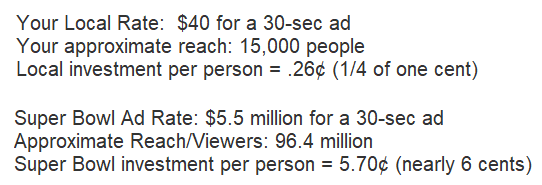
1) Whether it’s a good ad or a bad ad, the price was still $5.5 million. Because Super Bowl ads are so extremely expensive, they put their best foot/effort forward. The same is true in your market; the price is the same regardless if it’s a good ad or a bad ad. Learn to write and create better ads!
2) Your local ads are far less expensive per-person than Super Bowl ads. Do the math. For example:
3) Stories make better ads. When it comes to “branding”, stories sell. Stories are remembered far, far, longer than a basic, who, what, when, and where ad. Every business has stories, and as media reps, it’s our job to uncover and tell these stories.
4) Words and sounds are more powerful than pictures. Take the picture away from most Super Bowl TV ads and leave the words, music, and sound effects, and you still have a really strong ad.
5) Celebrities. Why? Did you recognize John Travolta? I could only name approximately 6 of over 32 celebrities featured in super bowl ads (…and who was the half-time entertainer???)
The goal should always be to do what is best for our clients. Taking a few lessons from Super Bowl ads and sharing them with your clients will help you gain their trust and help you create better ads.
Whether it’s an ad during a major event or an ad on any given week… Don’t you want people to “lean forward” every time their ad is aired?
If you would like help training your sales team on how to write and create better ads, click here to arrange a time to visit with us about our programs.
The definition of average is, “a number expressing the central or typical value in a set of data, in particular the mode, median, or (most commonly) the mean, which is calculated by dividing the sum of the values in the set by their number”.
If you’re an Account Executive, do you know what your average invoice is? Sales Managers, do you know what the average invoice is for each seller and your entire team?
Before you can “increase” your average, you must first know what your average is, and knowing your average invoice is a great place to start to increase your billing.
“The goal is not to be better than others; it’s to be better than your previous self.”
– Dalai Lama XIV
I’m going to assume that if you are in the sales world, you didn’t come into it saying, “I just want to be average”, or as the definition suggests, “typical”. The goal should be, at minimum, better than average. Of course, as we all achieve to be better than average, that average rises… but then, so does your income!
Here are a few quick examples of knowing what “average invoice” is and how shooting to be better than average can and will increase your billing.
Senior Seller “A” has on average 30 accounts on the air each month. His/her average billing is $45,000 per month. Their average invoice is $1,500.00. Going forward, if Seller “A” increases their average ask by $120, they will increase their billing by $3,600 a month and their income by 8%. Not bad for asking only $120 more per proposal.
Small Market “A”, on average, has 420 invoices that go out each month. Their monthly billing averages $82,000 which equates to an average invoice of $193.00. By simply increasing their average proposal or package to $211 per month, an $18 increase, this station would increase its annual billing by over $90,000.00.
Your current average invoice is, in essence, what your sellers believe your stations are worth. By simply paying attention to the average invoice and focusing on increasing that average, you and your sellers will be well on your way to better days ahead.
Averages can be deceiving, but understanding your average invoice and managing your average invoice will yield revenue results. Focusing on even the slightest improvement in average invoices each month, over time, will produce huge results.
If we are to believe everything we read, brick-n-mortar retail would soon be extinct and nearly everything we purchase would be done online. At least that is what the e-commerce world wants the public to believe.
Unfortunately for local retailers, this was the song that was being sung long before COVID-19, Dr. Fauci, and “new normal” were household names. In large part, the e-commerce community is creating all the hype behind the climb of online shopping and it’s taking over traditional brick-n-mortar shopping.
It is true? To a degree, yes! E-commerce is growing, but prior to the pandemic so were brick-n-mortar sales. According to a report from Digital Commerce 360, US Commerce Department, e-commerce made up only 16% of total US retail sales in 2019 (5% in 2007). 16%! That’s nothing to sneeze at and it’s growing. However, good ole fashioned brick-n-mortar grew at 3.5% and still did 84% of all retail sales. That’s 5-times more than e-commerce. Here’s what the dollars in digits looked like in 2019:
I’m not saying that brick-n-mortar can rest on its laurels. Actually, my point is just the opposite. To survive, brick-n-mortar needs to get creative. Conducting business the old-fashioned way isn’t going to be enough to compete and be profitable in the future.
For now, humans are still human, and humans need interaction with other humans. Our job as media professionals is to not just sell ads but to help business owners attract customers. Until robots rule the day, (which in my opinion will be a long-long time) and regardless of the propaganda the e-commerce world puts out, we need to continue to bring IDEAS to business owners.
As media reps, we need to help businesses create and build an emotional connection or “Brand Awareness” among the public. One thing that hasn’t changed is that people still buy on emotion and only justify with logic!
The moral of this story is this… WE need to tell the story that it’s not all doom and gloom for retailers. Good ole brick-n-mortar, for now and well into the future, is still King!