|
Business owners, especially when dealing with advertising, seldom factor in the lifetime value of gaining one new customer. The same, unfortunately, may be said about advertising reps as well.
The definition of CLV, Customer Lifetime Value, is the total worth to a business of a customer over the whole period of their relationship.
In many conversations with business owners, we have all heard them say, “Well, in order to get a good return on my advertising investment, I need to sell x-number of units or x-amount of dollars”. What they are failing to take into consideration is the value of a single new customer over the lifetime of their relationship.
The challenge is not just understanding how to accurately calculate CLV but how to explain the long-term impact to a client so that it makes sense and is believable.
The basic CLV formula is simple; the Average Purchase Value x Average Purchase Frequency x How Many Purchases a Year x Average # of Years they remain a customer.
For example: Average Purchase of $300 x 3 purchase a year = $900/year x 7 years as a customer = $6300 Customer Lifetime Value.
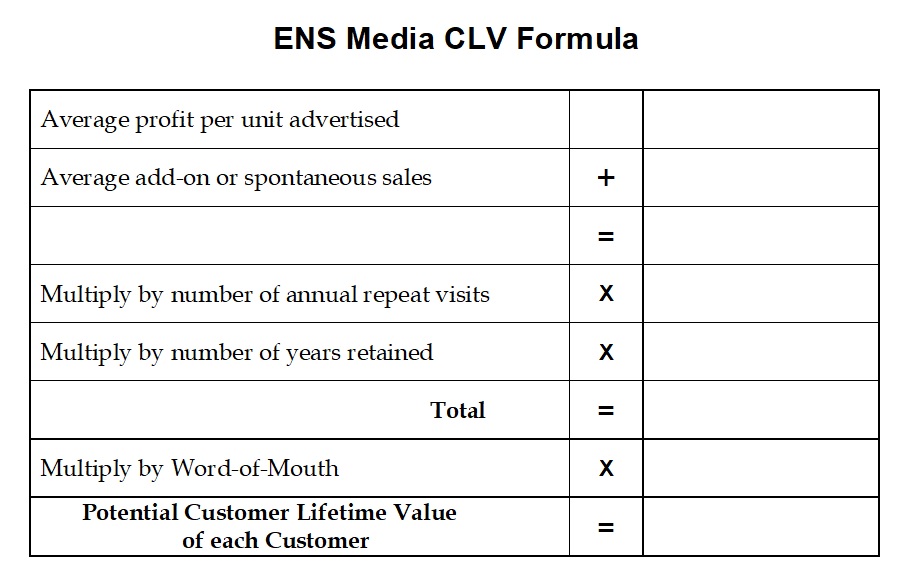
The ENS Media formula that we suggest using goes a bit deeper and is more accurate and believable when dealing with the ROI of advertising. We use 5 factors in determining the Customer’s Lifetime Value:
- The average “profit” per unit/sale (of advertised product/service)
- Add-on sales
- # of purchases per year
- # of years they remain a customer
- Word of Mouth (# of people they persuade to purchase from the business)
The two things that make this formula so powerful (and believable) are steps one and five. In step one we use “profit” instead of price. Business owners will relate and appreciate that you use this instead of the actual retail price. In addition, we recommend using the word “advertised”, which resonates with them as well. The word advertised is used when running a sales event or advertising a specific product or service. If you are running a long-term branding campaign, you can simply exclude the word “advertised”.
In step five we factor in the value of Word-of-Mouth. Far too often media reps fail to mention or suggest this. Creating Word-of-Mouth is one of the things radio does best, and we absolutely should get credit for it. It takes people or customers to create Word-of-Mouth advertising. If your ad campaign brings in new customers, who in turn tell their family and friends, you should at least get some of the credit for the initial introduction.
|