Yearly Archives: 2021

Nobody – Never – Everyone

Be honest… when was the last time you used these words or others like them when talking about other advertising mediums or your competition? In return, when was the last time a client or prospect used these words, and you became defensive?

It’s common to hear comments from clients like:

“Nobody listens to radio anymore, do they? I never listen to radio anymore!”

“Isn’t everyone on Facebook?”, or…

“No one is on Facebook today, isn’t everyone on Instagram or Tic-Tok?”

“Everyone has a social media account.”

“Everyone gets their music from Pandora, Spotify, or SiriusXM.”

“Nobody reads the newspaper anymore!”

“No one listens to, watches, or reads commercials.”

In return, as media reps we say things like:

“No one uses Facebook anymore!”

“Nobody reads the newspaper today!”

“Everyone still listens to radio.”

“Nobody watches regular TV these days!”

If you are using these words in this context, Stop! Nobody, Never, and Everyone are overused, misleading, and dangerous words.

However, when they are spoken by a client, a prospect, or even by yourself, you can use them to your advantage. Knowing when you use them, catching yourself, and then correcting yourself can be immensely powerful.

Clients want to hear the truth. For example, if you catch yourself saying, “No one reads the newspaper anymore”, it’s an opportunity to say, “Pardon me, I misspoke. Actually, there are lots of people that still read the newspaper, just not nearly as many as a few years ago and unfortunately for the newspaper industry, that number continues to slide”. If your client says this, correct them. They’ll respect you for it and then ultimately trust you more because of it.

On the other hand, if a client makes a bold statement and says something like, “Nobody listens to radio anymore”, don’t immediately get defensive and refute what they said. Instead, say something like, “Why do you think that”, or, “What makes you say this?” Find out what they are thinking before you answer.

Knowing the statistic as to how many people consume the different mediums and platforms is especially important. After all, knowledge is power, but knowing the proper way to respond to our clients is even more powerful.

The old saying “Never say Never” is true, and so are, “Never say Nobody” and “Never say Everyone”! If and when they are spoken, use them to your advantage!

Raising Kids – Raising Sellers!

You Have Two Minutes to Get Me in A Good Mood!

(The article I’m sharing with you today was first written nearly two years ago but never sent out to our subscribers. As we are spending time with our son and his family on vacation and watching them raise and guide their children, it reminded me of the similarities of raising kids and managing sellers.)

A few weeks ago, I wrote about my youngest daughter’s “Last First Day of School”. It was just a few days later that my second child and oldest daughter, a 1st-grade teacher, called me on her way to work like she does nearly every morning. Normally, she is in a very good mood and happier than most people are at 7:15 a.m. On this morning, to say the least, she wasn’t! In fact, her first words were, “You have two minutes to get me into a good mood”, and I could tell by the tone, she meant business!

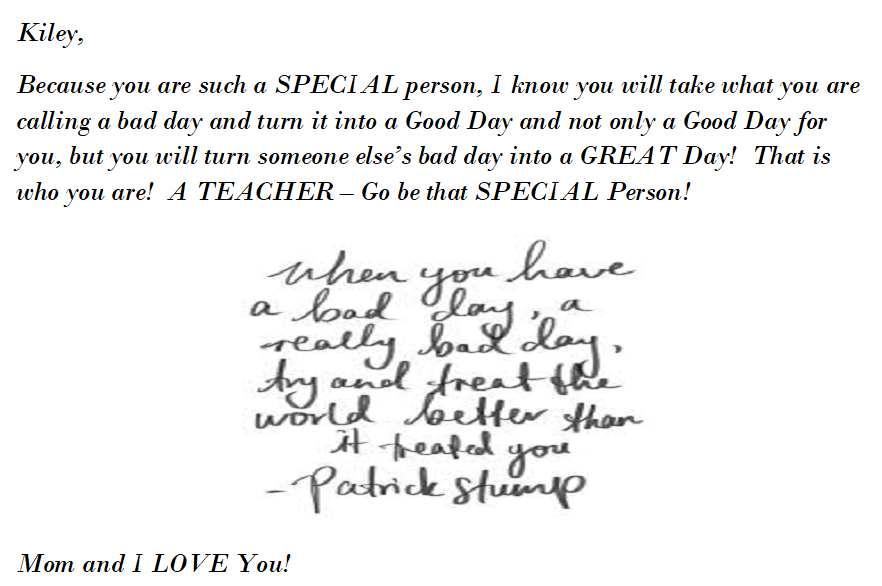
So we talked a bit and in about two minutes, maybe a couple more, she was ready to conquer the day. Shortly after that, I sent her this email and quote to give her one last pep talk.

Later, during her break, she replied with this…

“Thanks, Dad! I am actually having a good day. I am constantly talking to my kids about changing their mindset. Example: If they say, ‘I’m not good at this’, they should actually say, ‘What am I missing?’”. I told them about my morning, and they said, “CHANGE YOUR MINDSET!” Ha-Ha

Love you!”

One of our sayings in our home is, “You have to know what losing tastes like in order to truly enjoy the sweetness of victory”.

Why do I share these stories of my kids? Because it mirrors what we do in sales and management.

If you’re in management, we need to keep an eye out for our reps who might be having a bad day. Invite them in to talk about it and make sure they understand that it’s O.K. to have bad days.

If you’re in sales, you really do need to understand what defeat feels like to truly enjoy the wins. If we won every time, we wouldn’t enjoy or appreciate it nearly as much!

Everyone has “Bad Days”; after all, we are all human.

I hope these two minutes helped make your day a little bit better! Go make it a GREAT Day!

You’re Not That Good

I stole the title and the majority of this article from one of my favorite authors and philosophers, Seth Godin. If you haven’t read his books or his daily writings, I highly recommend that you do.

Seth’s article that I am sharing with you today, I thought, fits perfectly into the philosophy of not allowing yourself, regardless of your success, to think that you’ve learned everything you could, and to not stop trying and working to get better every day!

Below is a copy of his post. I’ve added the lessons that I took from his words of wisdom.

I hope you enjoy it!

“You’re not that good”

“These are the three problems with creative work.”

“The first is that when we begin, we’re not that good. This is a fact. The breakthrough for anyone on this journey is adding the word “yet”.”

“It doesn’t pay to pretend that we’ve figured it out before we have. It’s counterproductive to adopt a brittle attitude in the face of criticism. In fact, during this stage, “you’re not that good,” is precisely what we need to hear, because it might be followed with insight on how to get better.”

Lesson: When media reps start out, they are not that good, and we shouldn’t expect them to be. The fact is that it can be dangerous if we think they know more than we do. However, if we train them, they will get there. We just aren’t there, “yet”!

“The second is that once we start to build skills and offer something of value, some people are going to persist in believing that we’re not that good. Fine. They’ve told us something about themselves and what they want and need. This is a clue to offer our leadership and contribution to someone else, someone who gets what we’re doing and wants it. The smallest viable audience isn’t a compromise, it’s a path forward. Find the folks who are enrolled and open and eager. Serve them instead.”

“The danger is that when you hear rejection during this stage, you might come to believe that you’ve accomplished nothing, as opposed to realizing that you might simply be talking to the wrong people.”

Lesson: Not everyone will buy into what we say or suggest. Patience really is a virtue in radio sales. Find the people that have the desire to grow their business and work with them.

“And the third comes full circle. Because it’s possible that in fact, we’re not that good yet, and there aren’t enough people who want what we’ve got. We’re simply not good enough for this part of the market. So, we embrace that truth and begin at the beginning. We’re not good enough yet. We haven’t practiced enough, found enough empathy, understood the genre well enough and figured out how to contribute. Yet. At least for this audience.”

“And then we get better.”

Lesson: Never get too big for your britches. Regardless of how good we think we are, we can always get better. Even when you have been doing this for years, you still have room for more knowledge. Never stop searching and learning different and better ways to help your customers.

“Sooner or later, these three problems become three milestones on the road to making a difference and doing work we are proud of.”

Lesson:    NEVER Stop Learning – Get Better Every Day!
Some Things Are Better Left Unsaid

When you were growing up, you may have heard the expression, “Some things are just better left unsaid”. It was another way of saying hold your tongue because if you say it out loud, it could land you in trouble, or it may cause unpleasantness.

In advertising sales, one of those “things” better left unsaid until the appropriate time is…rates!

However, oftentimes it’s one of the first things new prospects want to talk about. When this happens, how we reply can set the stage and determine what type of relationship we will have with this client far into the future.

So, while we are better off not talking about rates, especially early in the relationship, the topic, especially when asked, needs to be addressed.

When one of your prospect’s first questions is, “What are your rates?”, you must be prepared. Answering the question directly and with as much confidence as possible is extremely important. The worst possible thing you can do is try to skirt the question and give them a song and dance reply!

Here is a suggested reply: “Our rates are great. I can assure you of one thing, we don’t gouge people and we don’t give it away.” Our rates are determined by several factors that include what station and/or how many stations you are on, the time frame in which your ads air, how much frequency you choose to run, the length of the agreement, and the length of the message. With that said, your rates will be somewhere between $__ and $__.”

If you choose to use something like this, make sure the rates you provide are fairly broad, allowing you room to explain the rates you present based on the reasons stated above, i.e. a 30-sec ROS schedule compared to 60-sec drive- times on one or multiple stations.

What we don’t want to have happen is to get into a discussion about our rates vs. the other radio station(s), or comparing the cost of radio to other mediums. The deeper you go with your reply, the more rate will be an issue.

As quickly as possible you want the conversation to turn to how we can help them grow their business with strategies, ideas, solutions, and results!

The right time to discuss rates is after you have presented your ideas and proven that you are there to help them, not just sell them. Then, regardless of what your rates are, they will always appear lower.

Do you want to be known as the media rep with the best rates or the media rep with the best ideas? Having a pre-planned and rehearsed response to this question can determine what your relationship will look like far into the future.

Some things are better left unsaid, or at least said in the appropriate manner, at the appropriate time!

Questions – Keep a Couple in Your Pocket

My dad had a lot of little sayings that had far greater meanings than just the few words spoken. Things like, “Can’t never could do anything”, “Do as I say, not as I do”, “Believe only half of what you see and none of what you hear”, and this one, “It’s best to keep a couple in your pocket”.

I think the saying “keep a couple in your pocket” originally meant to always keep a couple of coins or dollars on you, and more than once it referenced keeping a few pieces of candy for later in the day! But I also recall him saying, “You don’t need to tell them everything up front. Hold back some of your questions, thoughts, and knowledge for a more appropriate time. Sometimes, timing is everything”.

Others might say something like, “hold your cards close to your chest/vest” or “don’t show all your cards until it’s time to play”.

Regardless of how you express it, using this wisdom in sales at the appropriate time can have a powerful impact.

One of the areas in which I used this wisdom was when conducting CNAs. I would ask all of the normal questions, but, in many cases, I would intentionally hold back two or three questions. Then, at the end of the meeting, I would say to the prospect, “We’ll go back to the office, prepare our ideas and put our recommendations together for you. In the meantime, if I have a few additional questions, do you mind if I call you or set up another appointment to discuss?”

In addition to asking better and deeper questions upfront, this is where we start to separate ourselves from our competition. In a few days or a week, we would call the prospect back and either ask the questions or set up another appointment. I would say something like, “Mr./Mrs. Prospect, I believe we have some really good ideas put together for you, but I do have a few additional questions before preparing our final suggestions. Do you have 10-15 minutes to sit down and discuss?”, or if they don’t have time to meet face-to-face, ask them, “Do you have time to answer a few questions?”

The reason, and goal, for doing this is that subconsciously, we are going above and beyond what other media reps might be doing by putting additional thought into their business, and going the extra mile by thinking the process completely through.

This little tactic is not necessarily a game-changer. You’ll still need to have a great idea, but by keeping a “couple of questions in your pockets” and asking them at an appropriate time, you can certainly capture their attention enough to help position yourself differently from your competitors!

…and in the case of candy, you will never be disappointed that you kept a couple in your pocket!