Author Archives: ensonsales

Turning “No” into Magic  

One of the most frightening words for a media rep to say to a prospect or client is, “No”!

“No, we cannot offer that rate for that time frame.” “No, I can’t get you on tomorrow. We are past the production deadline!” “No, I can’t get you on this week. We are sold out”. “No, we can’t match the price of our competitor!” “No, No, No, and No!”

The natural fear of a media rep is that if I say “No”, they won’t ever do business with me again.

However, when it’s justifiable and the timing is right, saying “No” can be extremely powerful and almost “magical” in helping establish a more credible and professional future relationship with your clients.

Here are a few other times when saying “No” can have a great positive impact:

  1. When the client calls and says that they want to see you yet today or tomorrow. Saying “No” and that you can’t make it then will suggest that he isn’t your only client and that your other clients have value to you.

  2. When the client wants to run a schedule or do something that you are confident won’t have much chance for success. Tell them, “No, Mr./Mrs., I wouldn’t feel comfortable suggesting you do that, as I’m not at all confident it will work”.

There are two important ingredients to turning “No” into magic. One, you must train your reps on the “how” and “when” to use “No”. Not training them on this topic and expecting them to know it will leave them afraid of it. Equally as important, is giving them permission to say no, therefore taking away the fear of being reprimanded when or if the client should decide to walk.

If you want to gain and maintain the respect of your clients, and want more than just a token buy, say “No” once in a while.

Love at First Sight – Who Get’s the Credit?

Is there such a thing as love at first sight? Sure there is, but in most cases, it’s a process. The question is… Who gets the credit for closing the deal?

Here’s a real-life example of the point I’m trying to make.

Through a mutual friend, I introduce Gary to Bonnie. I then arrange, through another mutual friend, to provide Bonnie’s phone number to Gary.

Shortly after, they go on their first date and have a good time. After several dates that include dinners at nice restaurants, movies, and even some flowers, she invites Gary to meet her family. They begin dating more seriously on a regular basis. Then, Bonnie’s dad, being an avid hunter like Gary, invites Gary on a bear hunting excursion.

Ultimately, one nervous night, under a romantic full moon, Gary gets up the nerve to ask Bonnie to marry him. She says, “Yes”, accepts his ring, and the sale is made.

Who gets credit for the sale? Me, the friend who introduced them? The restaurants, movie theatres, or flower shops? Bonnie’s dad? The months of dating and getting to know each other? The ring? Or how about the full moon?

Human behavior, including perceptions, attitudes, relationships, and buying decisions is seldom based upon one singular event, but rather on a series of events, experiences, and influences.

Advertising is no different. Many advertisers give all the credit of the sale to the “moon”, or the last touchpoint. Years ago, it was the newspaper or yellow pages. Today, it’s Google and social analytics that now provide a “Last Interaction Attribution Model” and give 100% of the credit for a sale, which they call a “conversion”, to the clicks that immediately precede the sale.

And… advertisers, hungry to measure the ROI (Return on Investment) of every expenditure, eat it up!

The “Last Interaction Attribution Model” would leave out me, the friend who introduced Gary to Bonnie, the countless dates, good times, the hunting trip, and give all the credit for the marriage to the “moon”.

Are you and your people trained to understand the Purchasing Funnel and the Targeting Pyramid? Are you able to explain, articulate, and sell radio’s role in the entire “conversion” process from introduction, to building a relationship, branding, and asking for the order?

Digital media and last-touch clicks shouldn’t get all the credit. All exposures play a role in what those in search of ROI call “conversion”. In reality, there is no single source that can take credit for the sale and no single source that can make the sale without the influence of other touchpoints along the path to conversion.

 P.S. Gary and Bonnie have been happily married for almost 25 years, and like radio’s role in the Purchasing Funnel, I’m proud to take my fair share of the credit!!

Click here to inquire about facilitating a workshop for your annual sales conference or broadcast association to train local radio account executives on how to sell Radio’s ROI.

Nobody – Never – Everyone

Be honest… when was the last time you used these words or others like them when talking about other advertising mediums or your competition? In return, when was the last time a client or prospect used these words, and you became defensive?

It’s common to hear comments from clients like:

“Nobody listens to radio anymore, do they? I never listen to radio anymore!”

“Isn’t everyone on Facebook?”, or…

“No one is on Facebook today, isn’t everyone on Instagram or Tic-Tok?”

“Everyone has a social media account.”

“Everyone gets their music from Pandora, Spotify, or SiriusXM.”

“Nobody reads the newspaper anymore!”

“No one listens to, watches, or reads commercials.”

In return, as media reps we say things like:

“No one uses Facebook anymore!”

“Nobody reads the newspaper today!”

“Everyone still listens to radio.”

“Nobody watches regular TV these days!”

If you are using these words in this context, Stop! Nobody, Never, and Everyone are overused, misleading, and dangerous words.

However, when they are spoken by a client, a prospect, or even by yourself, you can use them to your advantage. Knowing when you use them, catching yourself, and then correcting yourself can be immensely powerful.

Clients want to hear the truth. For example, if you catch yourself saying, “No one reads the newspaper anymore”, it’s an opportunity to say, “Pardon me, I misspoke. Actually, there are lots of people that still read the newspaper, just not nearly as many as a few years ago and unfortunately for the newspaper industry, that number continues to slide”. If your client says this, correct them. They’ll respect you for it and then ultimately trust you more because of it.

On the other hand, if a client makes a bold statement and says something like, “Nobody listens to radio anymore”, don’t immediately get defensive and refute what they said. Instead, say something like, “Why do you think that”, or, “What makes you say this?” Find out what they are thinking before you answer.

Knowing the statistic as to how many people consume the different mediums and platforms is especially important. After all, knowledge is power, but knowing the proper way to respond to our clients is even more powerful.

The old saying “Never say Never” is true, and so are, “Never say Nobody” and “Never say Everyone”! If and when they are spoken, use them to your advantage!

Raising Kids – Raising Sellers!

You Have Two Minutes to Get Me in A Good Mood!

(The article I’m sharing with you today was first written nearly two years ago but never sent out to our subscribers. As we are spending time with our son and his family on vacation and watching them raise and guide their children, it reminded me of the similarities of raising kids and managing sellers.)

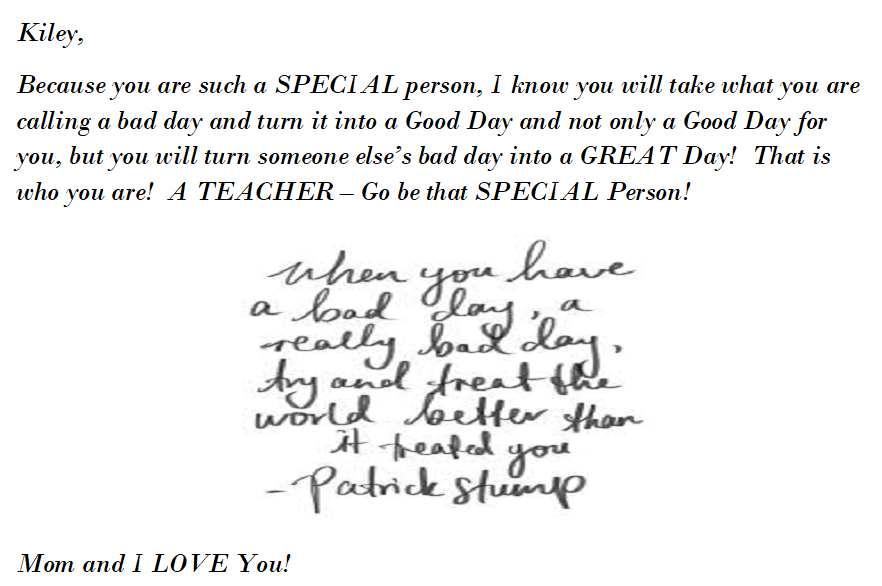
A few weeks ago, I wrote about my youngest daughter’s “Last First Day of School”. It was just a few days later that my second child and oldest daughter, a 1st-grade teacher, called me on her way to work like she does nearly every morning. Normally, she is in a very good mood and happier than most people are at 7:15 a.m. On this morning, to say the least, she wasn’t! In fact, her first words were, “You have two minutes to get me into a good mood”, and I could tell by the tone, she meant business!

So we talked a bit and in about two minutes, maybe a couple more, she was ready to conquer the day. Shortly after that, I sent her this email and quote to give her one last pep talk.

Later, during her break, she replied with this…

“Thanks, Dad! I am actually having a good day. I am constantly talking to my kids about changing their mindset. Example: If they say, ‘I’m not good at this’, they should actually say, ‘What am I missing?’”. I told them about my morning, and they said, “CHANGE YOUR MINDSET!” Ha-Ha

Love you!”

One of our sayings in our home is, “You have to know what losing tastes like in order to truly enjoy the sweetness of victory”.

Why do I share these stories of my kids? Because it mirrors what we do in sales and management.

If you’re in management, we need to keep an eye out for our reps who might be having a bad day. Invite them in to talk about it and make sure they understand that it’s O.K. to have bad days.

If you’re in sales, you really do need to understand what defeat feels like to truly enjoy the wins. If we won every time, we wouldn’t enjoy or appreciate it nearly as much!

Everyone has “Bad Days”; after all, we are all human.

I hope these two minutes helped make your day a little bit better! Go make it a GREAT Day!

You’re Not That Good

I stole the title and the majority of this article from one of my favorite authors and philosophers, Seth Godin. If you haven’t read his books or his daily writings, I highly recommend that you do.

Seth’s article that I am sharing with you today, I thought, fits perfectly into the philosophy of not allowing yourself, regardless of your success, to think that you’ve learned everything you could, and to not stop trying and working to get better every day!

Below is a copy of his post. I’ve added the lessons that I took from his words of wisdom.

I hope you enjoy it!

“You’re not that good”

“These are the three problems with creative work.”

“The first is that when we begin, we’re not that good. This is a fact. The breakthrough for anyone on this journey is adding the word “yet”.”

“It doesn’t pay to pretend that we’ve figured it out before we have. It’s counterproductive to adopt a brittle attitude in the face of criticism. In fact, during this stage, “you’re not that good,” is precisely what we need to hear, because it might be followed with insight on how to get better.”

Lesson: When media reps start out, they are not that good, and we shouldn’t expect them to be. The fact is that it can be dangerous if we think they know more than we do. However, if we train them, they will get there. We just aren’t there, “yet”!

“The second is that once we start to build skills and offer something of value, some people are going to persist in believing that we’re not that good. Fine. They’ve told us something about themselves and what they want and need. This is a clue to offer our leadership and contribution to someone else, someone who gets what we’re doing and wants it. The smallest viable audience isn’t a compromise, it’s a path forward. Find the folks who are enrolled and open and eager. Serve them instead.”

“The danger is that when you hear rejection during this stage, you might come to believe that you’ve accomplished nothing, as opposed to realizing that you might simply be talking to the wrong people.”

Lesson: Not everyone will buy into what we say or suggest. Patience really is a virtue in radio sales. Find the people that have the desire to grow their business and work with them.

“And the third comes full circle. Because it’s possible that in fact, we’re not that good yet, and there aren’t enough people who want what we’ve got. We’re simply not good enough for this part of the market. So, we embrace that truth and begin at the beginning. We’re not good enough yet. We haven’t practiced enough, found enough empathy, understood the genre well enough and figured out how to contribute. Yet. At least for this audience.”

“And then we get better.”

Lesson: Never get too big for your britches. Regardless of how good we think we are, we can always get better. Even when you have been doing this for years, you still have room for more knowledge. Never stop searching and learning different and better ways to help your customers.

“Sooner or later, these three problems become three milestones on the road to making a difference and doing work we are proud of.”

Lesson:    NEVER Stop Learning – Get Better Every Day!