Category Archives: Copywriting

creative is the engine

Creative is Not a “Nice to Have” – It’s the Whole Dang Engine

Let’s pretend your client’s Radio campaign is a car. 

Reach? That’s the tires. Strategy? That’s your GPS. Budget / Repetition? Absolutely, that’s the gas tank (enough “fuel” is very important). But the creative? That’s the engine that actually moves the thing forward. 

And according to a massive study by Nielsen and NCSolutions – we’re talking 450 campaigns across all kinds of media – guess what accounted for 49% of the sales lift? 

Bingo. The creative. 

Meanwhile, targeting (the thing most advertisers obsess over) was responsible for just 11%. Eleven! We’ll call that the cupholder. 

The crazy part – most marketers feel that only around 21% of ad effectiveness comes from the creative – when 49% does! And that 25% of ad effectiveness comes from targeting – when only 11% does! See video link from Cumulus Media | Westwood One Audio Active Group at the end of this article that illustrates this wide gap between perception and reality.  

Great creative is the part that makes people care. It’s the spark. The story. The laugh at a red light. It’s what earns trust, grabs attention, and gets remembered. 

Wouldn’t you like to separate yourself from all the other advertising salespeople out there who are touting all the same old crap – like reach, station rankings, demographics, impressions, etc.???!!! 

If your clients would ever question why you spend time crafting, refining, and rewriting radio scripts – tell them this: “Creative drives ROI.” Period. Not in the fluffy, artsy way. In the measurable, customers-in-the-door, dollars-in-the-till kind of way. 

Every time you present a campaign, you’re handing your client either a rusty old beater or a sleek, emotional powerhouse. They both might get airtime, but only one’s going to get results. 

Want to sell more effectively, renew easier, and cause your clients to love you more? 

Make better ads. 

Here’s a link to an 11-minute video from the “Cumulus Media Westwood One Audio Active Group” YouTube channel that summarizes the studies mentioned above very nicely. https://www.youtube.com/watch?v=p-wZxQaROuI 

Note: At about the 4:30 mark, it says, “Creative is a key driver of advertising performance… second only to investment levels”. Meaning, don’t skimp on the number of ads you schedule. Repetition is very key. Targeting, not so much. 
Specifics are sticky image

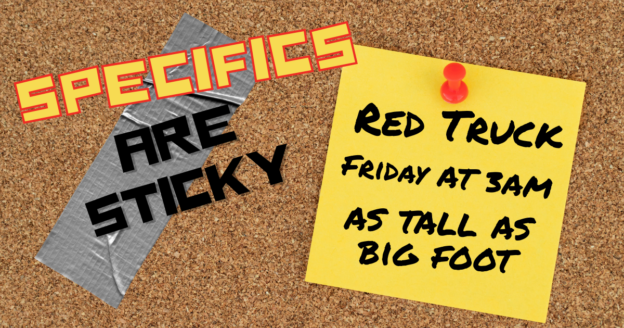
Specifics are Sticky

When writing radio ads, the details are everything. The difference between an ad that fades into the background and one that sticks in a listener’s memory often comes down to one thing – specifics. 

Vague statements like “we care about our customers” or “we have great prices” are forgettable. They’re wallpaper. They’re limp and useless. But say, “We answer the phone in three rings, even on Sundays,” and suddenly the listener sees it, believes it, and remembers it. Specifics build credibility. They paint a picture. They give the brain something to hold onto. 

When writing for the ear, generalities slide right off. But details? Details dig in. They light up the senses. The sound of tires crunching gravel as someone pulls into their driveway. The smell of bacon on a Saturday morning. Say “2:13 a.m.” instead of “the middle of the night.” Those small touches invite the listener to feel the ad, not just hear it. 

People don’t remember generalities or trite phrases. They remember moments. So, give them moments – real, colorful, sensory moments. That’s where emotion lives. That’s where trust is built. 

Radio is a theater of the mind. You must paint a picture. If you want your ad to be listened to and remembered, don’t aim to be clever. Aim to be clear, bold, and tangible. Give your audience something they can see, smell, hear, or feel. 

Pull up a sampling of past ads you’ve written – you’ll probably notice they could use a lot more “color”. Start writing more specifically – today. If you’re short on specifics to work from, go ask your clients better questions (remember last week’s article?), and get the details you need to create better ads!  

Generalities and vagueness are forgettable. Specifics are sticky. Make your message stick. 

Cobwebs in Your Ad Copy – And How to Burn Them Off

At some point, while writing an ad, you’re going to hit the wall.

Eyebrows scrunched.
Forehead wrinkled like a Shar-Pei.
Coffee getting cold.
Cursor blinking at you like it’s mocking your existence.

You’ll think about giving up. Or giving in. Or giving your “World’s Messiest Desk” mug a one-way flight into drywall.

It feels like cobwebs are clogging your creativity.

And it’s usually one of two things.

First: You Don’t Have Enough Fuel

Creativity isn’t magic. It’s connection.

It’s taking something you’ve seen, experienced, learned, overheard, read, felt… and connecting it to the ONE clear point that you’re trying to make in your ad.

When your brain feels empty, it’s because you haven’t fed it.

Back in the day, I’d flip through Reader’s Digest and steal jokes for openers, watch stand-up comedy, save old print ads and headlines that got my attention, and read creative fiction writers. Now it might be a random podcast, a weird historical fact, a conversation at a coffee shop, a list of good analogies, or a great question you asked a client.

You don’t need inspiration.
You need input. And when you come across something good… write it down, save it, take a picture, etc.

If your copy feels thin, it’s probably because your discovery was thin.

No fuel. No fire.

Second: You’re Letting Distractions Win

If you have an average or good foundation of ad writing education, then the second reason your ads aren’t as good as they could be is distraction.

You were rushed, interrupted, or mentally half somewhere else.

Distractions are ad-writing killers.

You have to create an environment where your brain can actually work.

That might mean:

  • Headphones on.
  • Instrumental music only.
  • Phone face down.
  • Email closed.
  • Door shut. Or a “do not disturb” sign.

And sometimes it means bribing yourself like a 7-year-old.

“No lunch until this script is done.”
“Finish this ad and I can have my chocolate fix.”

Whatever works.

You don’t need the perfect mood. You need commitment.

Wrap Your Head Around the Human

Before you write a word, get obsessed with the target prospect.

Who are they?

What are they tired of?
What are they afraid of?
What do they secretly want?
How would they react to each sentence you write?

Imagine one person and write to them.

The Cobwebs of Copywriting Are:

  1. Lack of Information
  2. Lack of Focus

Fix those two, and your ads get better immediately.

brainstorming for ideas in radio sales and ad writing

Brainstorm Sandwich

I really like Seth Godin’s daily blog, called Seth’s Blog. He makes me think.
One of his recent articles, titled “A Writer’s Room”, really hit home.

It made me think about how often we try to do it all by ourselves. Armed with caffeine and determination, we lock ourselves in our offices trying to crank out the next great campaign or big idea. But creativity doesn’t thrive in a vacuum – it thrives in conversation.

Gathering coworkers, your production team, or other outside resources for a quick brainstorm can turn ordinary ideas into something remarkable.

Invite a few people for a “Brainstorm Sandwich”. It’s when you pick a quiet area to brainstorm for a client – and you bring the sandwiches.

Whether it’s a whiteboard / storyboard session, or just a focused conversation… it will be well worth your sandwich investment. Take good notes, record the audio on your phone, or better yet – both.

Diverse expertise and multiple perspectives bring more ideas to the surface. One idea brings another and another and another. Then, they feed off each other. The ideas that stick, then get refined and polished. It’s a win for you and a win for your clients.

“Both of us are always smarter than one of us.”

Now go schedule your Brainstorm Sandwich. It’s productive and delicious!

13 Revealing Questions That Win Trust with Your Radio Clients (and Better Radio Ads)

Ever wonder why some people seem to win clients for life – while others can’t get a call back? Well, it’s not because they have a slicker pitch or a better-looking proposal.

It’s because they ask better questions.

What’s the best way to get a new client and keep an existing one?
Earn their trust.
Earn their trust.
Earn their trust.

There are many ways to do that… but one of the best is by asking revealing questions – the kind that go beyond surface-level chit-chat.

When you ask better questions, you send a signal to the business owner’s brain that says, “This person actually gets it. They’re not just here to sell me something – they’re here to make it work.”

And there’s a bonus: better questions give you better answers.
Those answers become the building blocks of smarter ad strategies – the kind that separate your clients from their competition, fill your notebook with fresh ad ideas, and deepen your understanding of how to truly help them succeed.

Try asking questions like these:

  • What’s the most revealing comment you’ve ever heard from a customer?
  • Do people ever get your business confused with a competitor?
  • What’s harder today in running your business versus 5 years ago?
  • Have you noticed any change in your customers versus 5 years ago?
  • What’s one thing about your business that people don’t know?
  • What was the best year you ever had… and why was it such a good year?
  • Have you ever thought that the money you spend on advertising could be more effective?
  • What’s one thing that your top competitor does that you think brings them new customers?
  • What’s happened in your industry in the last 3 years to make things more difficult for you?
  • What do you see happening in your industry over the NEXT 3 years?
  • When you buy advertising, what are a couple of reasons for choosing which media you’ll use?
  • What’s your biggest grossing product or service?
  • What’s your most profitable product or service?

Coming up with better questions just takes practice. Take 45 minutes, undisturbed, and write down ten of your own revealing questions. Then, go through them again and make them better. Keep your list handy. Then, you can customize each question for any business you have in mind.

You might have clients who’ve been with you for years and you’ve never asked them questions like this. Schedule a meeting purely to learn more – not to sell. When you do, they’ll see you differently. They’ll trust you even more.

Anyone can sell an ad.
But only the ones who ask revealing questions become trusted advisors.

You’ll become the rep they look forward to talking to.