
Tag Archives: Advertising
You’ve Been Lied To
Have you ever had a business owner tell you after you made your presentation that they don’t have the budget? Sure, you have.
If you are dealing with the true decision-maker, you have just been lied to!
It’s not a lie in the sense that it was meant to hurt you. It was more of an excuse because they would rather say that than, “I don’t like your idea”, “I don’t think your station is the right fit”, or one of several other excuses that would ultimately put the blame on you and potentially hurt your feelings!
There are several lessons to learn from this example:
-
Make sure you are talking to the decision-maker from the very beginning.
-
If they are absolutely the decision-maker and they use this objection, dig deeper and find out what the real objection is. You might reply with something like, “Mr./Mrs. Business Owner, with all due respect, you are the person that makes all budgeting decisions. If you really liked the idea I presented and felt it would help grow your business, you would find the budget, correct? So, can I respectfully ask why you don’t want to move forward with this plan? I can assure you I won’t be offended by doing so.”
-
If you come up with a strong enough idea that they are convinced will give them a strong ROI, they’ll find the money. Side Note: Ask for what the idea is worth. Good ideas are worth Good money. Great ideas are worth Great money. If you have a GREAT idea, don’t be afraid to ask for a BIG budget!
Your job is to uncover the real reason why they said, “It’s not in the budget”. It’s then your job to tweak your plan accordingly, or if needed, re-load and come up with an altogether new proposal based on their feedback.
It’s not an easy question to ask, and it’s one you can and should practice prior to it ever happening. By not asking, you are simply prolonging them from ever buying from you.
Planning for 2020? To learn more about our TOMA Surveys and Seminars, SoundADvice e-Marketing Program, and our new Radio Recruitment Advertising Seminars, go to our website at www.ensmediausa.com.
Patience is a Virtue
When selling a new prospect advertising on your station, how long should it take to make the sale?
The correct answer is… as long as it takes, to do it right! Too fast or too slow can both have negative effects. But in most cases, moving too fast can have greater long-term negative effects than moving too slow. Patience, more often than not, is a virtue!
Keep in mind that media sales are different than automotive, furniture, or insurance sales. In advertising sales, if we lose the sale to a competitor or don’t make the sale today, there will nearly always be another opportunity tomorrow or in the very near future. In the automotive, insurance and other like categories, the urgency is much greater. They know if they don’t get the sale today, that person may well be out of the market tomorrow. However, even with that said, the best salespeople regardless of what they are selling, nearly always have patience.
In media sales, there are two factors that determine how long you should take:
1) The value of the client. Is it a long-term client or short-term? The more potential value the client has, the more patience you should have. Don’t rush in with ideas and plans that aren’t well-thought-out. Make sure you play your cards correctly.
2) How much time does the client/prospect need to trust you? Trust, takes time and if they trust you at the point when they say yes to your plan, the chances are much greater that they will give your plan the time it needs to work.
Even if they don’t trust you, they may buy from you once or twice, but without trust, the chances of them being with you long-term are very slim.
In my experience, most of the medium to large, long-term contracts my team wrote took a minimum of 3 months to close, and more often than not it took 6 months or more. But once they bought into the ideas and plans that we had taken our time to create for them, they were committed and stayed with the program.
18th-century Swiss philosopher Jean-Jacques Rousseau said it best, “Patience is bitter, but its fruit is sweet”. It takes time to reap the rewards.
When you find a potential client that has value, be patient with them. Take the time to come up with great ideas. Ask deeper questions. Show a keener interest in their business and use that time to build trust and rapport. Once they say yes, you’ll have them for a lifetime.
Patience is a Virtue!
The More They Know, The More They’ll Buy
The reason most business owners don’t like advertising is because they don’t understand advertising.
Do business owners understand the importance of having Top of Mind Awareness (TOMA) in their business category?
The more you educate your clients and prospects, not only are they more LIKELY to buy from you, but they will buy MORE from you!
If we are simply talking to clients about OUR stations, OUR ratings, and why advertising on the OUR stations is a good deal for them, they may buy, but chances are they will never buy as much from us as they can or should.
Educate them on the “How” and “Why” advertising works and watch your sales grow!
While the digital media world seems to receive all of the limelight today, our ENS Media Share of Mind Surveys and Seminars educate business owners on the important role that radio plays in creating Top of Mind Awareness, how important creating TOMA/brand awareness is in today’s competitive New Media world, and how radio works in conjunction with digital and social media in the buying process.
And…these Share of Mind Surveys and Seminars may be one of the best training and educational tools your sales team has ever seen!
To learn the top 12 ways your advertisers, and your sales team, can benefit from facilitating Share-of-Mind Surveys and Seminars in your market, click here.
The Powerful Point
7 Criteria to Effective Advertising
Hopefully, over these past 4 weeks, you now have a better understanding of how to use and explain the 7 criteria to clients and help them better understand how important each is to advertising.
In the first issue of this series, it mentioned we use this piece to make two specific points; One is to explain to clients how to get a better return on their advertising investment, and two is how to use it to build trust with your prospects and clients.
I also stated that I would share a powerful point that is intended to position the media rep and/or your stations in a very positive light. That is what we are covering today and how we will conclude this series.
At some point during the CNA or one of the first meetings with a client, the conversation will lead to a point where you can bring up the 7 criteria. When it does, we suggest you either pull out a prepared “7 Criteria to Effective Advertising” form on your station letterhead or simply write the 7 criteria on a sheet of paper or a restaurant napkin.
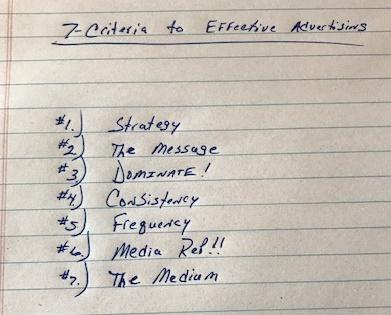
After writing this out and going over each of the criteria is when you make your powerful point, by saying…
“Mr./Mrs. Client, actually, the most important criteria is #6”. (Draw an arrow from #6 Media Rep up above the #1 position and write “#1 Media Rep!”)
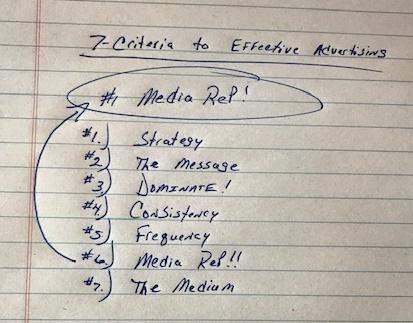
Continue by saying…
“If you find a media rep or media group that understands criteria #1 through #6; how to create Strategy, how to create and write effective messages/ads, how to use your advertising budget to dominate, and the importance of Consistency and Frequency… If you have someone that ‘gets this’, then the medium or the station that you choose really doesn’t matter. If you follow these criteria, your advertising will be way more effective. Mr./Mrs. Client, I understand how to do this, and I can help you get a better return on your advertising dollars”.
You have just established yourself as something different than the average media rep who talks about their stations, their media, and their ratings, and you’ve also taken rates and ratings out of the equation.
I hope that you have found the 7 Criteria for Effective Advertising useful. If you have any comments or questions, simply send me an email or give me a call.
If you would like to receive the one-page form of the “7 Criteria for Effective Advertising”, click here and we will be happy to send it to you. You can use it on ENS Media’s letterhead or feel free to transfer it to your station’s letterhead to use in your sales calls and presentations.